 Multi Fasteners
Flange types: weld neck, slip-on, blind and more, with faces and sizes
There are around nine flange types in common use, and each one joins pipe in a different way. This guide covers the main flange types (weld neck, slip-on, socket weld, threaded, lap joint, plate, blind and spectacle blind), the three flange face types, a class 150 flange size chart and which gasket goes with which face.
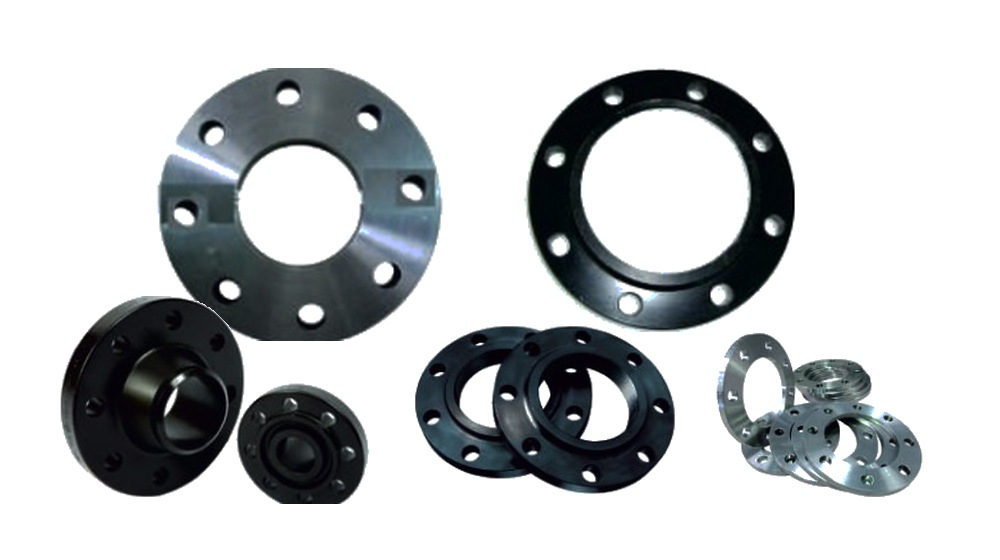
Flange meaning: what a flange does
A flange is a ring or plate fixed to the end of a pipe, valve or pump so it can be bolted to a matching flange. A gasket sits between the two faces and the bolts squeeze it to make the seal. The joint can be opened again for cleaning, inspection or replacement, which is the main reason to flange a line rather than weld it all the way through.
For steel pipe flanges, ASME B16.5 covers sizes from 1/2 in to 24 in in pressure classes 150, 300, 400, 600, 900, 1500 and 2500. The class sets the flange thickness, bolt count and bolt size. European flanges follow EN 1092-1 and are rated by PN (PN6, PN10, PN16 and so on). The two systems do not bolt together, so always confirm which one the line uses.
The main flange types compared
| Type | How it joins the pipe | Strength | Typical use |
|---|---|---|---|
| Weld neck | Butt welded through a long tapered hub | Highest | High pressure, high temperature and cyclic service |
| Slip-on | Slides over the pipe, fillet welded inside and outside | Medium | General service, water, air, low pressure process |
| Socket weld | Pipe sits in a socket, one fillet weld outside | Medium to high | Small bore, higher pressure lines |
| Threaded | Screws onto threaded pipe, no welding | Lower | Small utility lines and areas where hot work is not allowed |
| Lap joint | Loose over a stub end that is welded to the pipe | Medium | Lines that need easy bolt alignment or frequent dismantling |
| Plate | Flat plate, fillet welded to the pipe | Lower | Low pressure water, air and drainage |
| Blind | Solid disc, no bore | Rated to its class | Closing a line end or nozzle, pressure testing |
| Spectacle blind | Fits between two flanges | Rated to its class | Positive isolation that can be swung open or closed |
Weld neck flange
A weld neck flange has a long tapered hub that is butt welded to the pipe. The taper spreads stress from the flange into the pipe wall, so it handles high pressure, temperature swings and vibration better than any other type. The bore is matched to the pipe schedule, so order it with the schedule (for example SCH 40 or SCH 80) as well as the size. It costs more and needs accurate cutting and bevelling, but it is the default for critical lines.
Slip-on flange
A slip-on flange slides over the pipe end and is fillet welded on the outside and on the inside face. It is cheaper than a weld neck, needs less precise pipe cutting and is easier to line up on site. The trade-off is lower strength under internal pressure and a shorter fatigue life, so it suits general service rather than severe duty.
Slip-on vs weld neck: which to choose
Choose a weld neck when the line runs at high pressure or temperature, sees vibration or thermal cycling, or carries flammable or toxic fluid. Choose a slip-on for water, air, cooling and other general lines where cost and fit-up time matter more. If the specification is silent and the line is critical, the weld neck is the safer choice.
Blind, spectacle blind and backing ring
A blind flange is a solid disc that closes the end of a pipe, valve or vessel nozzle. It carries the full line pressure plus the bolt load, so in larger sizes and higher classes it is one of the thickest flanges in the set. It is also used to close a line for hydrotest.
A spectacle blind is a figure-eight plate with one solid end and one open ring, joined by a web. It sits between two flanges and is turned to block the line or let flow through, giving visible isolation for maintenance. ASME B16.48 covers line blanks of this kind.
A backing ring is a loose ring used with a stub end, in the same way as a lap joint flange. Because the ring never touches the fluid, it can be plain steel while the stub end matches the pipe material.
Flange face types: RF, FF and RTJ
| Face | What it looks like | Gasket | Where it is used |
|---|---|---|---|
| Raised face (RF) | Sealing area stands proud of the bolt circle | Ring gasket inside the bolts: non-asbestos or spiral wound | Most process and industrial flanges |
| Flat face (FF) | Face is flat across its full width | Full face gasket covering the bolt holes, often rubber | Mating with cast iron pumps and valves, low pressure water |
| Ring type joint (RTJ) | Machined groove in the face | Solid metal ring | High pressure and high temperature service |
Never bolt a raised face flange to a flat face cast iron flange: tightening the bolts can crack the cast iron. Use a flat face flange with a full face gasket instead.
Flange gasket: matching the gasket to the flange
- Non-asbestos flange gasket: general RF flanges in water, air, oil and low pressure steam
- Rubber flange gasket: FF flanges and low pressure water lines
- Spiral wound gasket: RF flanges at higher pressure or temperature
- Ring joint gasket (RTJ): RTJ faced flanges only, sized to the groove
A gasket is sized by pipe size and flange class (or PN), so give both when ordering.
Flange size chart: ASME B16.5 class 150
The table below gives outside diameter, bolt circle and bolting for class 150 flanges, the most common class in general service. Use it to check an existing flange; confirm against the standard before fabrication.
| Size (NPS) | Flange OD | Bolt circle | Bolts |
|---|---|---|---|
| 1/2 in | 89 mm (3.50 in) | 60.3 mm | 4 x 1/2 in |
| 3/4 in | 98 mm (3.88 in) | 69.8 mm | 4 x 1/2 in |
| 1 in | 108 mm (4.25 in) | 79.4 mm | 4 x 1/2 in |
| 1 1/2 in | 127 mm (5.00 in) | 98.4 mm | 4 x 1/2 in |
| 2 in | 152 mm (6.00 in) | 120.7 mm | 4 x 5/8 in |
| 3 in | 190 mm (7.50 in) | 152.4 mm | 4 x 5/8 in |
| 4 in | 229 mm (9.00 in) | 190.5 mm | 8 x 5/8 in |
| 6 in | 279 mm (11.00 in) | 241.3 mm | 8 x 3/4 in |
| 8 in | 343 mm (13.50 in) | 298.5 mm | 8 x 3/4 in |
| 10 in | 406 mm (16.00 in) | 362.0 mm | 12 x 7/8 in |
| 12 in | 483 mm (19.00 in) | 431.8 mm | 12 x 7/8 in |
Ordering: what to specify
To get a quote that matches first time, send these for each line:
- Type: weld neck, slip-on, blind, socket weld, threaded, lap joint, plate or spectacle blind
- Size: nominal bore, for example 2 in or 6 in
- Class or PN: for example class 150 or PN16, and the standard if your drawing names one
- Face: RF, FF or RTJ
- Material: mild steel, or aluminium for slip-on, threaded and weld neck
- Schedule: for weld neck and socket weld flanges, the pipe schedule
For example: "Weld neck flange, 4 in, class 150, RF, SCH 40, mild steel, 20 pcs, with spiral wound gaskets." If you are unsure, send a photo of the existing flange with a tape across the bolt holes and we will help identify it.
Flanges and gaskets in Dubai
We stock threaded, slip-on, plate, welding neck, socket weld, lap joint, blind and spectacle blind flanges and backing rings in mild steel, plus aluminium slip-on, threaded and weld neck flanges, with gaskets to suit.