 Multi Fasteners
SS 304 or SS 316 pipe fittings for marine use
Both grades look identical on the shelf. The difference is one alloying element, and in salt water it decides whether a fitting lasts for years or starts pitting in months.
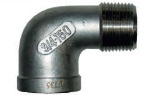
The difference is molybdenum
Both 304 and 316 are austenitic stainless steels that resist corrosion through a passive chromium oxide layer on the surface. The key distinction is that 316 contains molybdenum (typically around 2%), which 304 does not.
Molybdenum improves resistance to chlorides specifically. Chloride ions attack the passive layer at weak points and start localised pitting and crevice corrosion — the kind of damage that perforates a fitting while most of its surface still looks clean. Seawater, coastal air and many process chemicals are chloride-rich, which is exactly where 316 earns its cost.
Side by side
| SS 304 | SS 316 | |
|---|---|---|
| Molybdenum | None | ~2% |
| Chloride resistance | Moderate | High |
| Seawater service | Not recommended | Suitable |
| Relative cost | Lower | Higher |
| Typical use | Fresh water, air, indoor and general industrial lines | Marine, offshore, coastal, chemical and food-grade lines |
Which to specify
Choose 316 for anything in contact with seawater or brackish water, deck fittings and equipment exposed to salt spray, offshore and coastal installations, chemical transfer lines, and food or pharmaceutical duty. In the Gulf, coastal humidity and airborne salt mean that even equipment not touching the sea often justifies 316.
304 is sufficient for fresh water, compressed air, inland industrial lines and indoor building services, where chlorides are not a factor. Choosing 304 in those conditions is sound engineering, not a compromise.
If a specification simply says "stainless steel" without a grade and the application is marine, confirm before ordering — substituting 304 into a seawater line is one of the more expensive mistakes to discover later.
A note on mixing grades
Where fittings of different grades meet in the same wetted line, the less noble material can corrode preferentially. Keeping a line to a single grade avoids the question entirely, and is usually simpler than evaluating each junction.
Ordering
Give the pattern, size, grade and end type, for example "90 elbow, 1 in, SS 316, threaded". We stock both grades in elbows, tees, crosses, street elbows, unions, plugs, bushings, nipples, caps, reducers, sockets, hose nipples and locknuts.
SS 304 and 316 fittings in stock
Multi Fasteners stocks Both-Well stainless steel 304 and 316 pipe fittings in threaded and socket weld patterns, along with SS 316 camlock couplings for marine transfer lines.